Look at the glass on a shower door in Sherman Oaks after a month without a squeegee and you are looking at the same chemistry that shortens the life of a dishwasher heating element. Municipal water here arrives carrying a great deal of dissolved mineral. Every appliance that heats it, freezes it or holds it still keeps a little of that mineral, and none of them announce it. They just get slower and less effective until an owner decides something has broken.
The dishwasher shows it first
Deposits gather in four places inside the tub, and each one produces a different complaint. On the heating element they act as insulation, so the water never reaches the temperature the cycle expects and dishes come out warm and damp. In the spray arm jets they narrow the openings until the upper rack stops getting a proper wash. On the inlet valve screen they restrict fill and stretch the cycle. And around the float in the sump they can hold the switch high enough that the control stops the program partway through, on purpose, because the machine has been told it is flooding.
One test is worth running before you spend anything. Wipe a cloudy glass with white vinegar on a cloth and look again. If the film lifts, that is mineral and it can be managed. If the cloudiness stays put, the glass has been etched over years of hot washing, and no repair or product will bring it back.
Ice makers, where a little restriction goes a long way
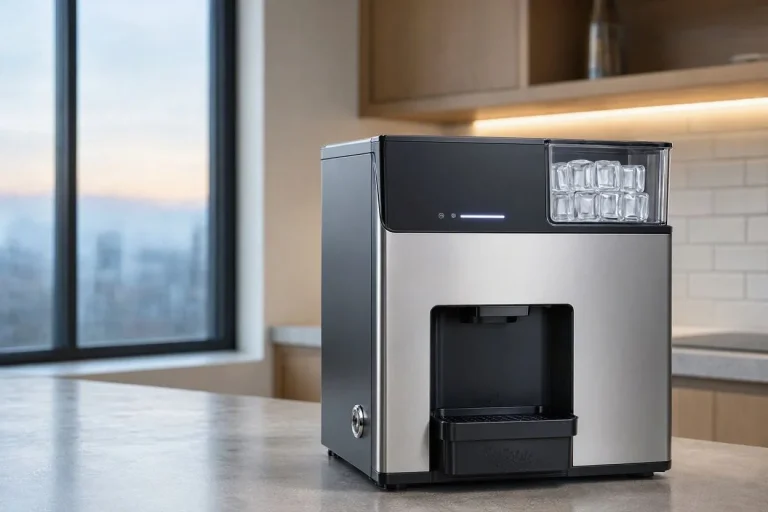
An ice maker meters a measured shot of water into the mold and freezes it on a timer. Scale on the fill valve screen and inside the supply tubing narrows that path by a fraction each season, so the shot arrives short and the machine freezes whatever it received. Hollow cubes, half-height cubes and a bin that never quite fills all trace back to the same restriction. Undercounter machines in Beverly Hills butler’s pantries and Calabasas outdoor kitchens run far more cycles than a refrigerator maker does, so they collect it faster.
Steam ovens and integrated coffee systems
These two are the least forgiving, because their water passages are the narrowest in the kitchen. A steam oven boils tap water and keeps the deposit in its boiler. A built-in Miele, Thermador, Wolf, Monogram or Bosch brewer pushes water through a boiler and a brew unit under pressure, and as those passages tighten the coffee weakens. Nothing has broken; the plumbing inside has closed up. The signal people miss is a descale routine that finishes and immediately asks to be run again. That is not a programming error. It is the machine reporting that one pass did not clear the buildup.
What is worth doing
- Descale on the calendar, not on the prompt. By the time a brewer or a steam oven asks, the deposit is established. Twice the frequency the manual suggests is reasonable in this water.
- Shorten the refrigerator filter interval. Six months is printed on the box as a general figure, not a local one. Four is a better habit here, and a filter costs a fraction of a service visit.
- Keep rinse aid in the reservoir. On a condensation-dry dishwasher it is part of how the machine sheds water, and it does more against spotting than anything poured into the tub.
- Pull and rinse the dishwasher filter monthly. Thirty seconds under the tap prevents the recirculating grit that people mistake for a dying pump.
- Consider treatment at the supply rather than at the appliance. A softener or a scale-reduction system fitted by a plumber protects everything downstream of it, and it is the only item here that addresses the cause instead of the consequences.
What a technician does with it
Scale is deferred maintenance, so these visits tend to be shorter and cheaper than owners expect. A dishwasher gets its element and thermistor metered, its inlet screen cleared, its spray arms flushed. An ice maker gets the valve screen and mold checked before anyone touches the harvest assembly. Where a part genuinely has to be replaced, the number for the job arrives after diagnosis, not before it, and the service call charge is deducted from it if you have the work done.
Universal Appliance Repair covers eleven towns across the Valley and the Westside. Call (818) 000-0000 and mention how the water behaves elsewhere in the house. It tells the technician what to expect inside the machine.